
Field service
Every installed unit, every call, every contract, billed right.
Equipment you installed or service is registered with its warranty and history. Calls start the SLA clock and become scheduled jobs or depot RMAs; the contract decides which lines the customer pays for; parts come out of the same stock the warehouse manages.

Problems it solves
- Service history scattered across e-mails and paper
- Technicians dispatched without knowing the contract terms
- SLA breaches noticed after the customer calls
- Parts used on jobs never relieved from stock
- Covered work billed, or billable work given away
Workflows
How a service business runs on Fritech ERP
Register the asset
Serial, site, model, install and warranty dates, and the history of jobs and RMAs on one record.
Learn moreTake the call
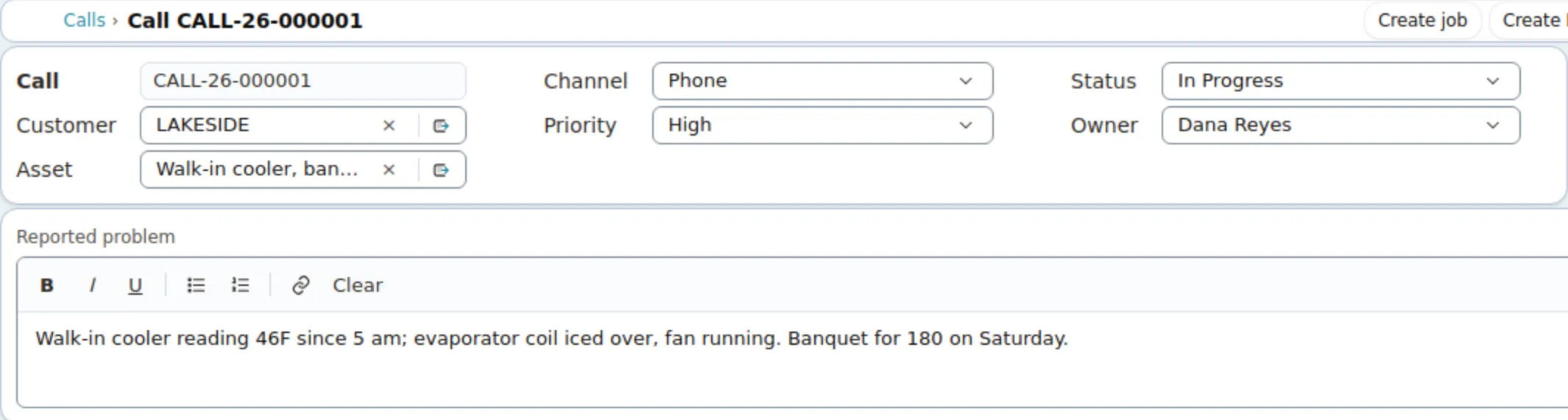
Channel, priority, asset and reported problem; the call spawns a job or an RMA and holds the SLA clock.
Learn moreDispatch
A calendar by technician with an unscheduled queue by priority and age; drag to schedule, SLA markers in view.
Learn moreApply the contract
Coverage percentages for labour, parts and fees and an incident quota; the most specific active contract applies, then the warranty.
Learn moreIssue parts from stock
Parts on the job come out of inventory at completion at actual cost, from the same stock the warehouse manages.
Learn moreBill the job
Completed jobs and resolved RMAs create one draft invoice from billable lines; an RMA can issue a credit note.
Learn moreContracts
Coverage decides what the customer pays.
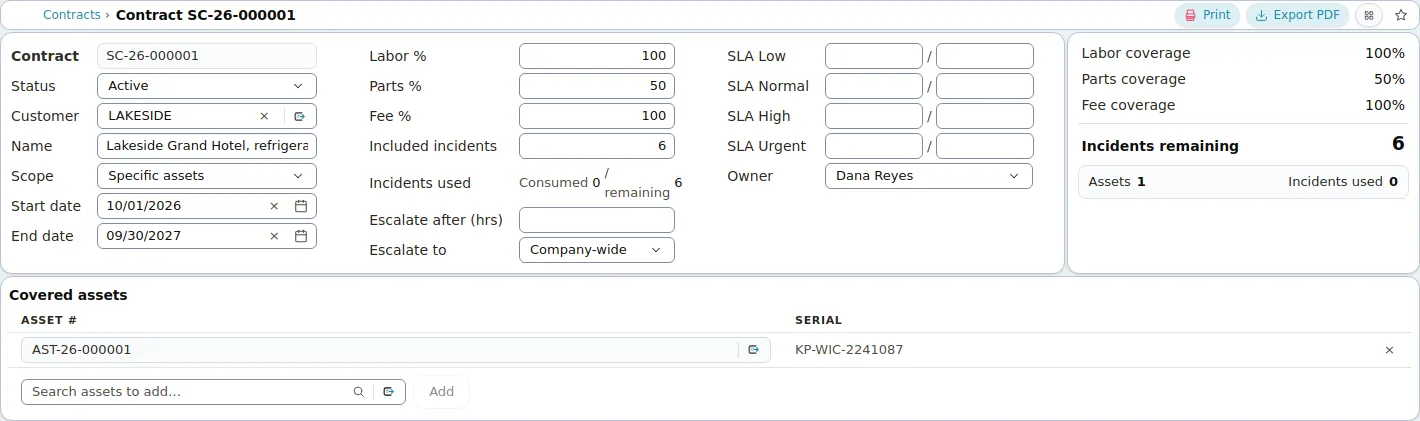
A contract covers specific assets, a customer, a model or a pool, with coverage percentages and an incident quota. Covered lines on a job default to non-billable; exhausted quotas are skipped and the asset warranty is the fallback.
Jobs
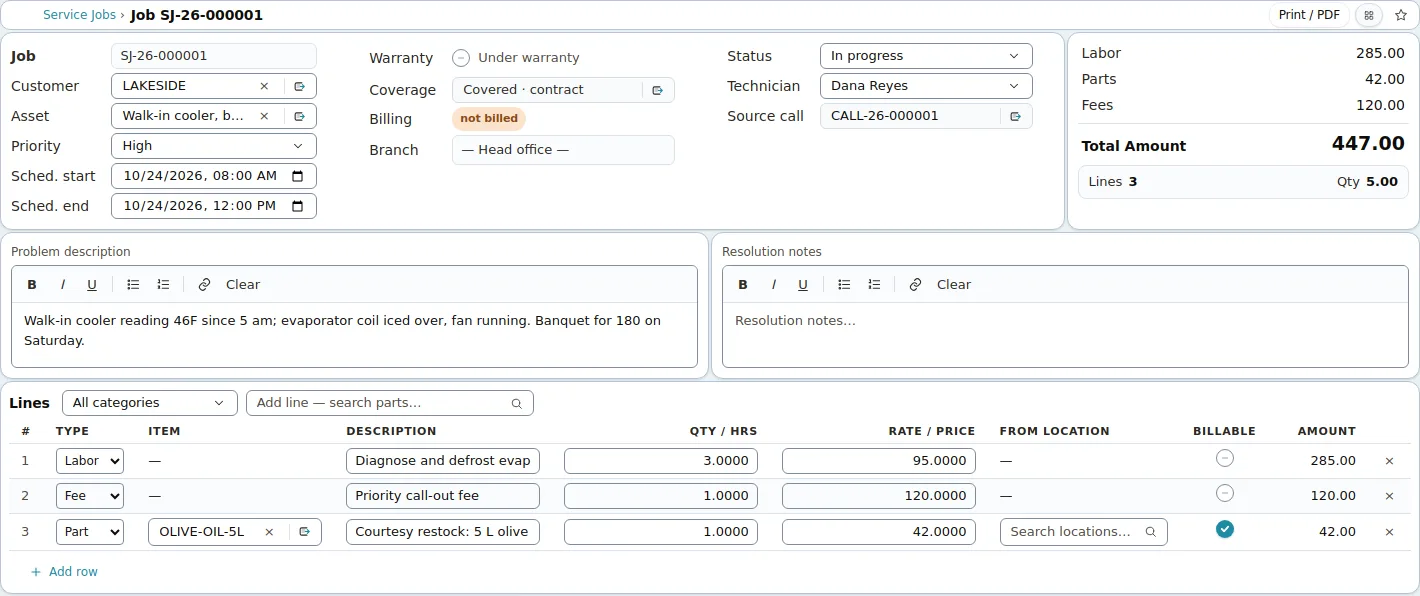
Labour, parts and fees, each marked billable or covered.
The job shows the technician, the schedule and every line with its billable flag. Parts are issued from stock when the job completes, and billing creates one draft invoice for the customer.
Capabilities behind it
The parts of the platform this solution runs on
- Service managementInstalled assets, calls, jobs, contracts with coverage, a dispatch board, SLA clocks and RMAs.Open
- Inventory and warehouseStock by warehouse, bin, lot and status; waves, directed putaway, counts and the scanner app.Open
- Finance and accountingA full general ledger with posting rules, period close, receivables, payables, banking and multi-currency.Open
- Sales and CRMQuotes, orders, one pricing rule set, leads, opportunities and a pipeline board.Open
Connect your field operations with service management and back-office workflows.
A demo on your own service calls: the installed asset, the contract behind it, the dispatch, the parts used and the invoice that follows.