
Service management
Installed equipment, repairs and contracts, billed right.
Equipment is registered as service assets with warranty and history. A call starts the SLA clock and spawns a scheduled job or a depot RMA; the contract decides which lines are billable; completed work bills through a draft invoice.
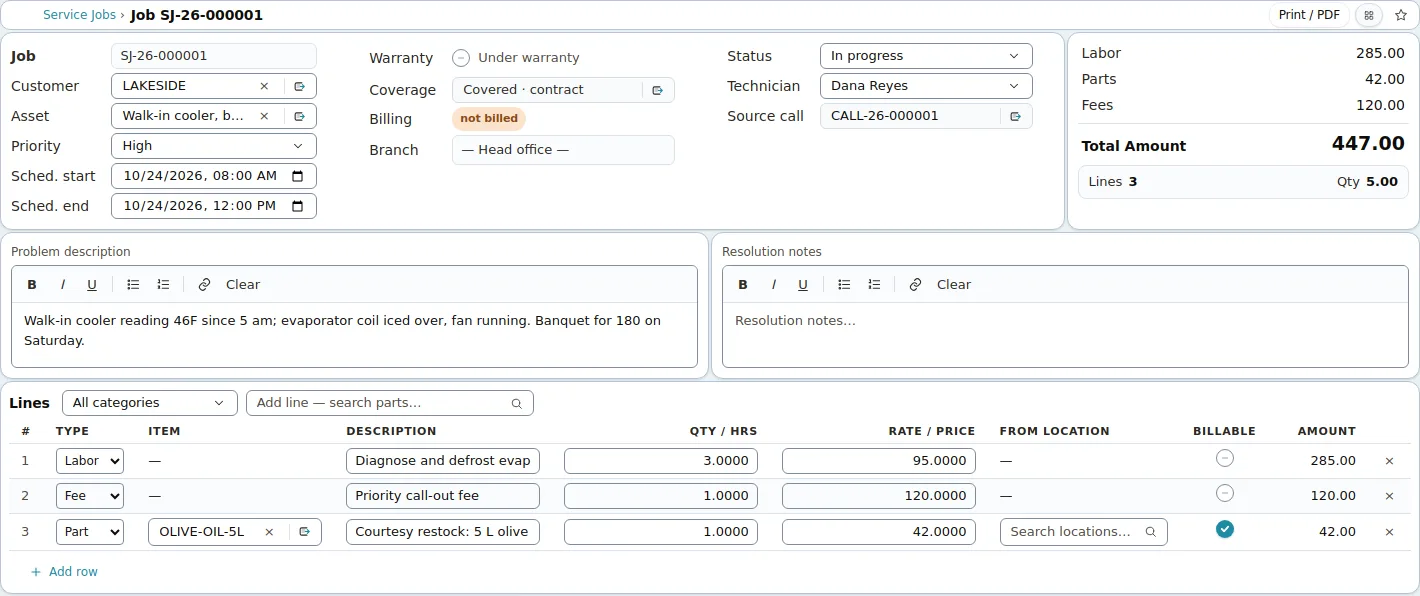
Screens shown are the product's own demo company, Harbor Foods. Figures are demo data.
Problems it solves
- Service history scattered across e-mails and paper
- Technicians dispatched without knowing the contract terms
- SLA breaches noticed after the customer calls
- Covered work billed, or billable work given away
Why it matters
What changes for your business.
One record per installed unit
Serial, site, warranty and the history of every job and RMA, on the asset.
The contract decides what is billable
Coverage percentages and incident quotas mark job lines covered or billable before the technician leaves.
Dispatch with the clock in view
A calendar by technician with the unscheduled queue and SLA markers; a monitor escalates breaches.
Contracts
Coverage decides what the customer pays.
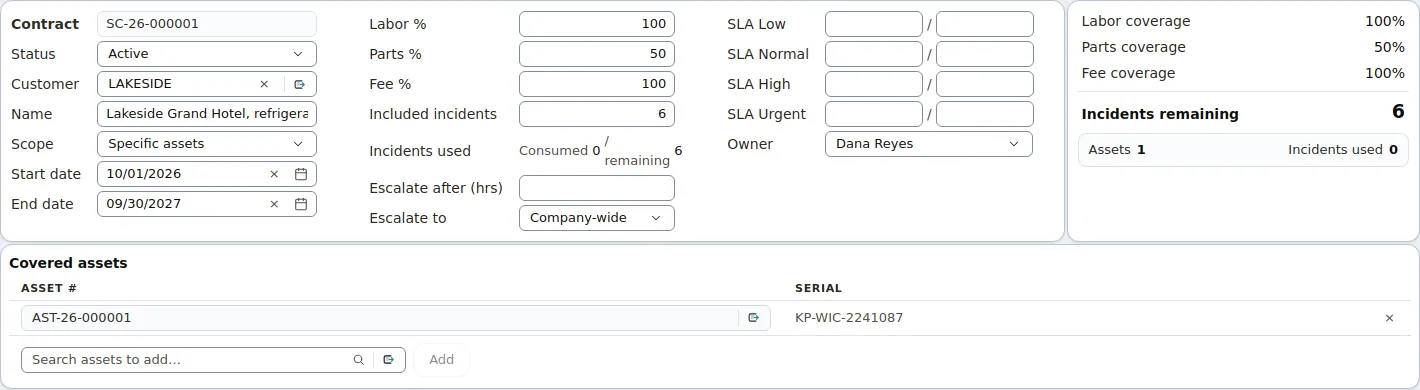
A contract states what it covers, in percent, for labour, parts and fees, and how many incidents are included. When a job is created under it, covered lines are non-billable by default and the remainder bills as usual.
In detail
What it covers
Everything this capability does, grouped. Open it for the specifics your IT team and power users will ask about.
Open the full listClose the list
In detail
What it covers
Everything this capability does, grouped. Open it for the specifics your IT team and power users will ask about.
Open the full listClose the listAssets and calls
- Service assets with serial, site, model, install and warranty dates, and a history of jobs and RMAs
- Service calls with channel, priority, asset and reported problem that spawn a job or an RMA and hold the SLA clock
- Dispatch board: calendar by technician, unscheduled queue by priority and age, drag to schedule, SLA markers
Jobs and RMAs
- Service jobs with labour, part and fee lines, technician and schedule; parts issued from stock at completion at actual cost
- Lines covered by warranty or contract default to non-billable
- RMAs: authorize, receive, repair, resolve by repair-and-return, scrap, replacement from stock or credit note, with carrier and tracking
Contracts and billing
- Service contracts covering assets, a customer, a model or a pool, with labour, parts and fee coverage percentages and an included-incident quota
- Coverage picks the most specific active contract and falls back to the asset warranty
- SLA response and resolution targets per priority; a monitor flags breaches and escalates to the contract's escalation user
- Completed jobs and resolved RMAs create one draft invoice from billable lines; an RMA can issue a credit note
Good to know
Before you implement, and what this capability does not do today.
We state limits plainly so your evaluation is based on the product as it is; ask in the demo about anything on the roadmap.
Implementation and integration notes
- Technicians work from the office app on any device; there is no dedicated technician app.
- SLA targets run in calendar hours; business-hours calendars are not available.
- Parts for jobs come from the same stock the warehouse manages, so service and inventory are set up together.
Current limits
- SLA clocks run in calendar hours, not business hours.
- There is no technician mobile app or customer service portal; technicians work from the office app on any device.
- No loaners or advance replacements on RMAs, labour rate cards, preventive-maintenance schedules or metered billing.
See Fritech ERP on your own order, receipt and month-end.
Tell us how your business works. We come back with a few times to choose from, and the demo runs in the product on your scenarios, not a slide deck.