
Projects and job costing
Every cost on the job, billed from the job.
Purchase lines, supplier bills and time entries are tagged with cost codes, so the job cost report shows budget, approved changes, committed, actual and billed per code without re-keying. Change orders, pay applications and retention run from the same project.
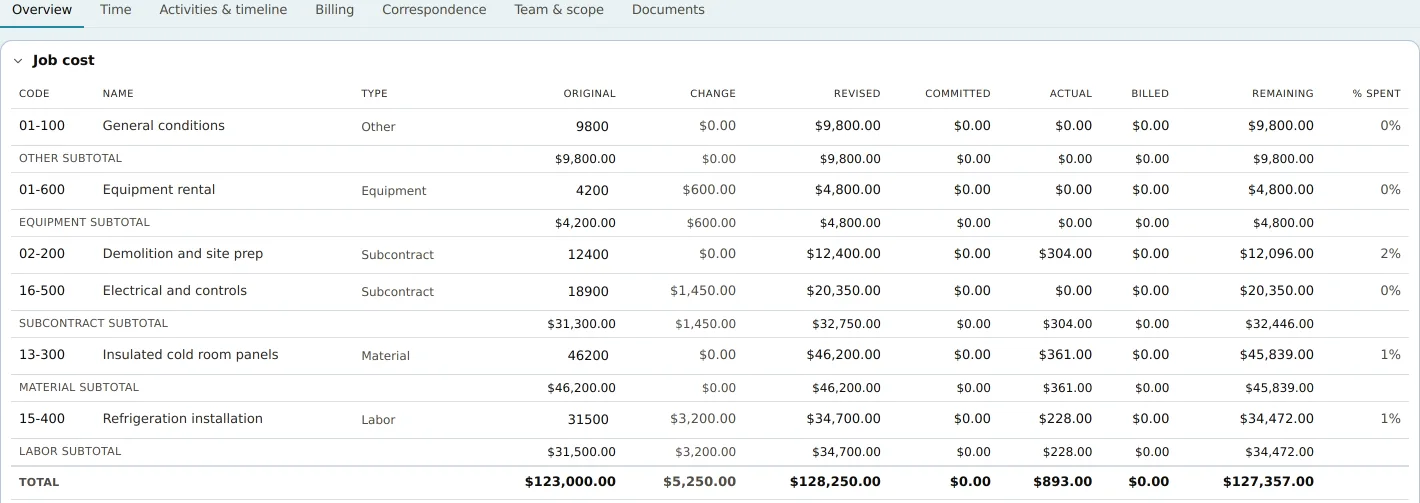
Screens shown are the product's own demo company, Harbor Foods. Figures are demo data.
Problems it solves
- Job cost assembled in spreadsheets weeks after the fact
- Change orders approved in e-mail and lost at billing time
- Pay applications re-typed from the schedule of values
- Retention tracked by memory
Why it matters
What changes for your business.
Every cost lands on the job
Purchase lines, supplier bills and hours carry a cost code, so the job cost report is always current.
Changes move the budget
Approved change orders raise the revised budget and contract on the report; nothing is re-keyed.
Progress billing without the spreadsheet
Pay applications are pre-filled from the last approved one and become draft invoices on approval.
Change orders
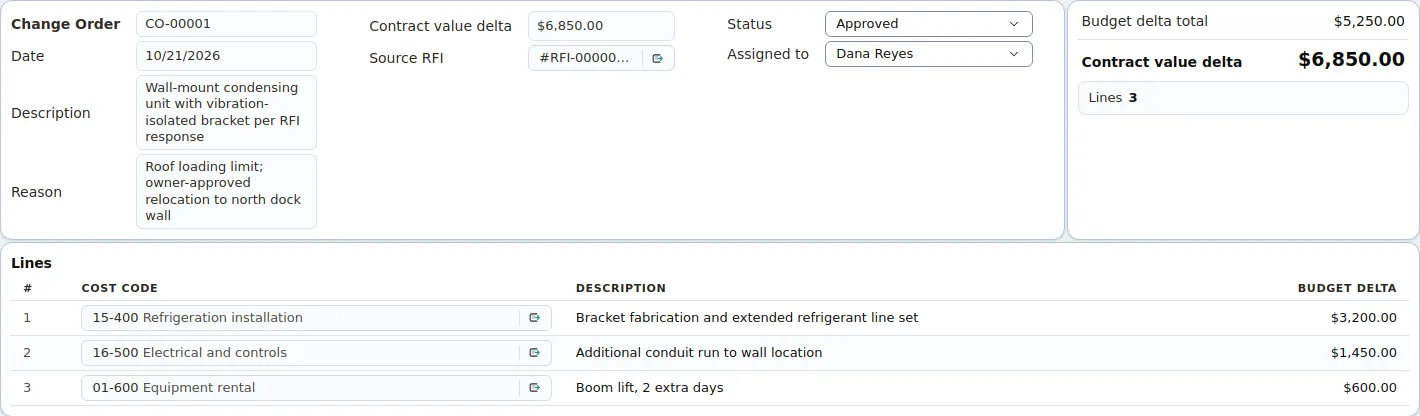
Approved changes move the budget and the contract.
A change order lists its budget deltas per cost code and the contract value delta. Approval raises the revised budget and contract on the job cost report; nothing posts to the ledger until the work is billed.
Pay applications
Progress billing with retention, line by line.
Each pay application shows completed to date, previous billed, this period and retention per schedule-of-values line. Approving it creates a draft invoice in receivables, so progress billing and the books stay in step.

In detail
What it covers
Everything this capability does, grouped. Open it for the specifics your IT team and power users will ask about.
Open the full listClose the list
In detail
What it covers
Everything this capability does, grouped. Open it for the specifics your IT team and power users will ask about.
Open the full listClose the listPlanning
- Projects with hourly or fixed-price billing, default rate, budget hours, manager, retention percentage and labour cost rate; copy as template
- Work breakdown structure up to eight levels with milestones, dependencies and lag, critical path and float computed read-only, Gantt with a today marker
- Team with allocation percentage and an over-allocation flag; a numbered scope register tied to schedule-of-values lines
Costing
- Cost codes with cost types on purchase order lines, bill lines and time entries
- Job cost report per code: original budget, approved change-order deltas, committed open purchase orders, actual bills plus labour, billed to date
- Time entries with billable flag, rate and description; spreadsheet import; billed entries locked
- Earned value (BAC, PV, EV, AC, SPI, CPI, EAC and more) as of a date, with an S-curve and named baselines
Billing
- Change orders with per-cost-code budget deltas and a contract value delta, from draft through submitted to approved, citing the source RFI
- Schedule of values with scheduled value per line; scope items drive percent complete
- Pay applications with a G703-style continuation sheet per line, pre-filled from the last approved application; approval creates a draft invoice
- Retention held, released and outstanding per project; a release is billed as a draft invoice
- RFIs and submittals with due dates, cost and schedule impact flags and review decisions
Good to know
Before you implement, and what this capability does not do today.
We state limits plainly so your evaluation is based on the product as it is; ask in the demo about anything on the roadmap.
Implementation and integration notes
- Cost codes and the schedule of values are agreed before the first project is loaded; open projects are migrated with their budgets.
- Time entries come from the office app or a spreadsheet import; there is no field time-clock app.
- Each project reports in one currency.
Current limits
- Time entries have no approval step; project expense entries are not available.
- Pay applications produce the G703-style continuation sheet, not a G702 cover sheet; retention has no separate receivable account.
- Earned value and the cockpit assume one currency per project; there is no automatic scheduling or resource levelling.
See Fritech ERP on your own order, receipt and month-end.
Tell us how your business works. We come back with a few times to choose from, and the demo runs in the product on your scenarios, not a slide deck.