
Manufacturing
From demand to finished goods, costed at standard.
Bills of materials carry revisions, scrap and alternates. Manufacturing orders issue components to work in progress, absorb labour and overhead from reported operations, and close at standard cost with the variance booked. MRP turns open orders and forecasts into dated planned orders.
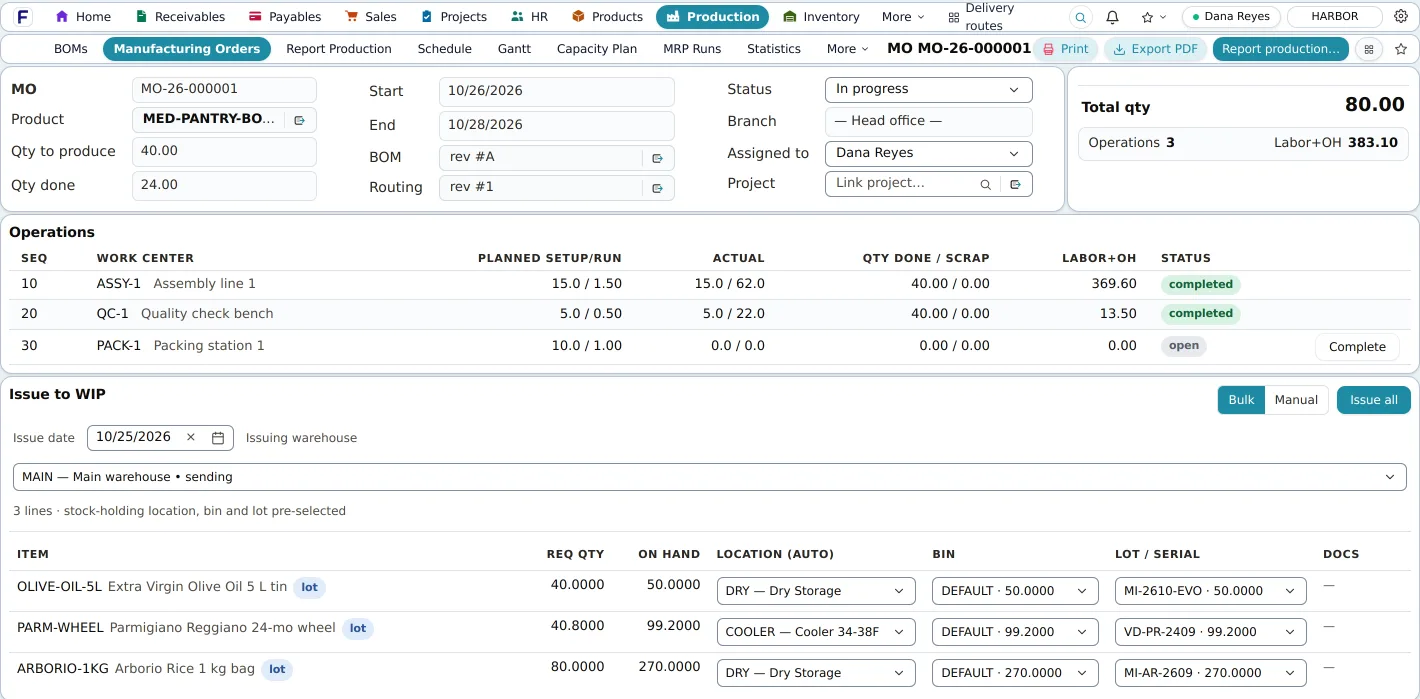
Screens shown are the product's own demo company, Harbor Foods. Figures are demo data.
Problems it solves
- Bills of materials kept in spreadsheets with no revision history
- Component shortages discovered on the floor
- Labour and overhead never reaching the cost of the product
- Purchasing that reacts instead of planning
Why it matters
What changes for your business.
Engineering with history
Revisions with effective dates, scrap, alternates and a cost roll-up through sub-assemblies.
Cost booked as work happens
Issues to WIP, reported operations and the standard-cost close post to the ledger without a spreadsheet in between.
Demand turned into dated orders
MRP nets open orders and forecasts against stock and supply, then lists what to buy and make, released in one click.
Bill of materials
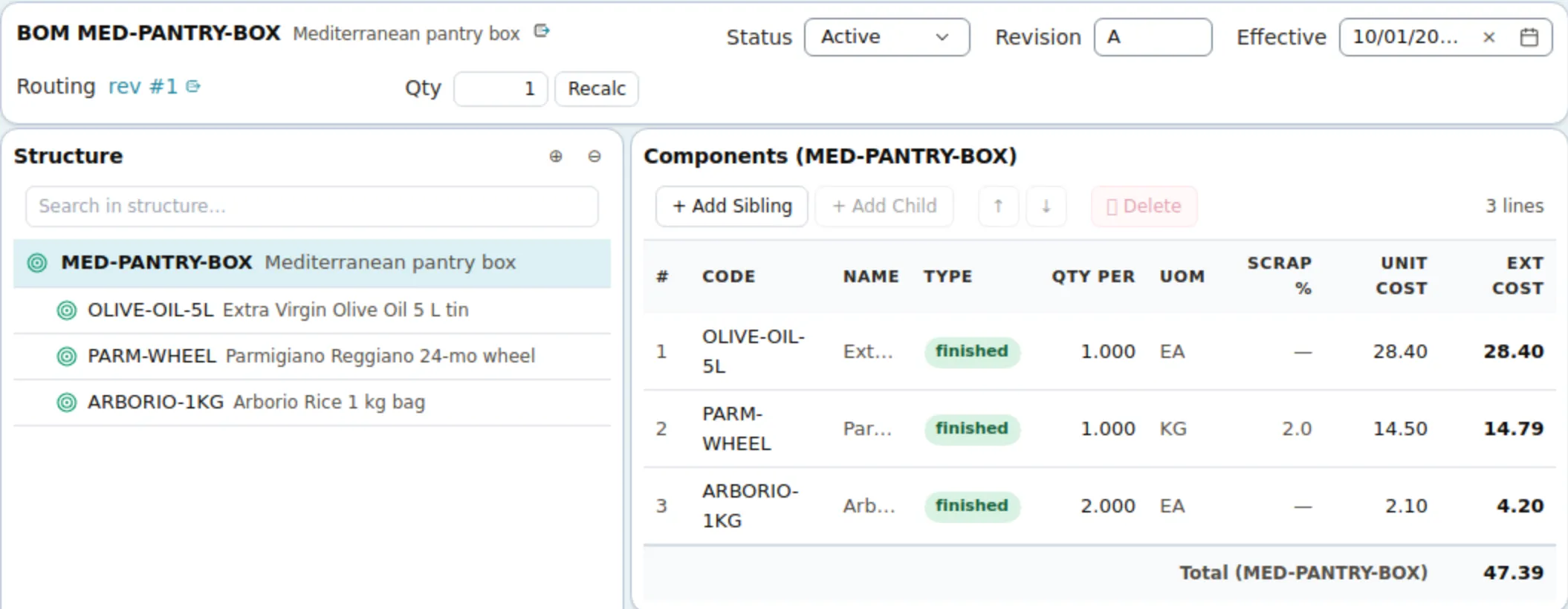
Revisions with scrap, alternates and a rolled-up cost.
Each revision has effective dates; activating one archives the previous. Components carry quantity per, scrap and the operation that consumes them, and the roll-up walks sub-assemblies and phantoms to a cost per unit.
MRP
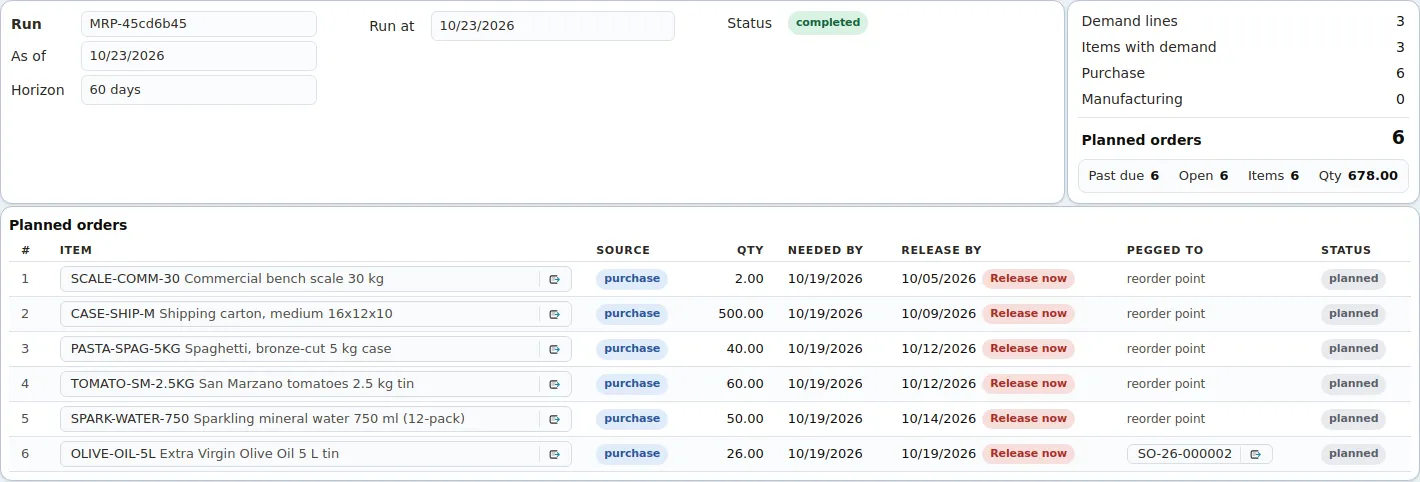
Dated planned orders, released in one click.
The MRP run lists what to buy and what to make, with the demand each planned order serves. Past-due needs come first, and every line can be released to a draft purchase order on the preferred vendor or to a manufacturing order.
In detail
What it covers
Everything this capability does, grouped. Open it for the specifics your IT team and power users will ask about.
Open the full listClose the list
In detail
What it covers
Everything this capability does, grouped. Open it for the specifics your IT team and power users will ask about.
Open the full listClose the listEngineering
- Bills of materials with revisions and effective dates; a tree editor with drag-and-drop, sub-assemblies, scrap percentage, units that must convert to the component's base unit
- Alternate components with a preferred one, offered at issue when the primary is short
- Revision compare line by line, multi-level explosion and cost roll-up through sub-assemblies and phantoms
- Routings with operations in sequence, work centers with capacity, cost per hour, overhead rate and calendar
- BOM line import from spreadsheets with per-row results
Production
- Manufacturing orders that snapshot the active BOM and routing: Planned, Released, In progress, Completed, Closed
- Issue to WIP by warehouse, lot and serial with shortages per line; a short sub-assembly raises a linked child order in one click
- Operation completion with actual setup and run minutes, completed and scrapped quantities; labour and overhead absorbed into WIP
- Report production into a warehouse, location and bin with lot, expiry and serials; partial reports; backflush for untracked components
- Standard-cost close that books favourable or unfavourable variance; traveler PDF per order
Planning
- MRP over a horizon (90 days by default): open sales orders and forecasts netted against stock, confirmed purchase lines and open orders, with lead-time offset, reorder point, safety stock and maximum stock
- Planned orders convert to draft purchase orders, requisitions or manufacturing orders, singly or in bulk
- Schedule calendar and Gantt, capacity plan of load against capacity per work center per day
- Production statistics: orders by status, on-time percentage, throughput, scrap rate, planned against actual minutes, cycle time
Good to know
Before you implement, and what this capability does not do today.
We state limits plainly so your evaluation is based on the product as it is; ask in the demo about anything on the roadmap.
Implementation and integration notes
- Finished goods are costed at standard; standard costs for made items are set during implementation.
- Work centers, routings and calendars are set up with you; the capacity plan shows load, it does not reschedule.
- Lot and serial tracking on components and finished goods is decided per item.
Current limits
- The capacity plan reports load only; there is no finite or constraint-based scheduling, and no pegging in MRP.
- No shop-floor terminal or scanning of manufacturing orders, co-products or by-products, subcontracted operations, or quality inspection on production.
- Finished goods close at standard cost; actual-cost or FIFO costing of finished goods is not available.
See Fritech ERP on your own order, receipt and month-end.
Tell us how your business works. We come back with a few times to choose from, and the demo runs in the product on your scenarios, not a slide deck.